

Amazon FBA packaging requirements are the rules for how each unit and shipping carton must be protected, sealed and labeled before it goes into a fulfillment center. In short: use a sealed, sturdy six-sided box or a clear poly bag at least 1.5 mil thick, add a suffocation warning to bags with an opening of 5 inches or more, make sure the item passes a 3-foot drop test, and put a scannable barcode on every unit. Since January 1, 2026, Amazon no longer fixes prep mistakes for you in the US, so getting it right yourself matters more than ever.
What changed in 2026
Amazon ended its FBA prep and labeling services in the US on January 1, 2026. That means FNSKU labeling, poly-bagging, bubble wrapping and boxing are now the seller’s job. Amazon’s packaging and prep pages in Seller Central are the source of truth, so check them every few months because Amazon updates them without much warning. Mistakes can mean a refused shipment, extra fees or a suppressed listing.
Packaging rules at a glance
| Packaging type | Key requirements |
|---|---|
| Boxed units | Six-sided, lid or opening will not open on its own, does not collapse under medium pressure, sealed with tape or glue |
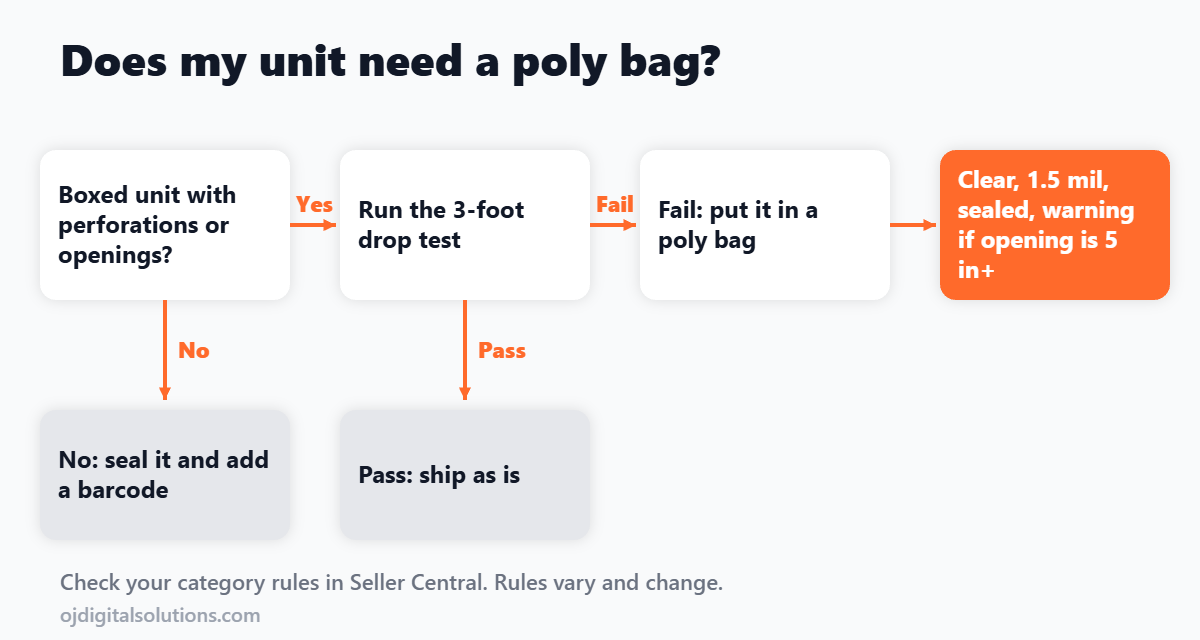
| Boxes with perforations or openings | Must pass a 3-foot drop test, or go inside a poly bag with a suffocation warning |
| Poly bags | Clear, at least 1.5 mil thick, fully sealed, not sticking out more than 3 inches past the product, scannable barcode |
| Bags with an opening of 5 inches or more | Need a printed or attached suffocation warning in the right size |
| Fragile items | Protected, for example with bubble wrap, and able to pass the 3-foot drop test |
| Footwear | No shoe material exposed, so use a shoe box or a poly bag with a warning |
| Adult products | Opaque black poly bag or shrink wrap |
| Sets | Clearly marked as a set so they are not separated, for example sold as set |
These are common rules and they vary by category. Always read the page for your category in Seller Central.
Boxes and the drop test
If a unit is boxed and the box has perforated sides or openings, it has to survive a 3-foot drop. The test drops it on each side and on a corner. If the contents break, spill or the box opens up, the unit fails and needs a poly bag with a suffocation warning on top. The easy fix is a solid box with no gaps, or inner protection that keeps the product from moving.
Poly bag rules
- Clear: the barcode must be scannable through the bag.
- At least 1.5 mil thick and fully sealed.
- Tight fit: no more than 3 inches of extra bag past the product.
- Warning for big openings: any bag with an opening of 5 inches or more, measured flat, needs a suffocation warning.
- Warning text size scales with the bag: bigger bags need bigger text, from about 10 point on small bags to 24 point on very large ones.
The warning wording Amazon gives is a plain safety message that says to keep the bag away from babies and children and that the bag is not a toy. You can buy bags with it already printed, or add a label.
Labels: unit barcodes and carton labels
- Unit barcode: every unit needs a scannable barcode, either the manufacturer barcode or an FNSKU label you print.
- FBA Box ID label: generated in Seller Central for each shipment, one per carton, commonly printed at 4 x 6 inches. Place it flat on the outside so it can be scanned, and never reuse an old one.
- Weight limits: cartons are generally capped at about 65 lb, with team lift labeling needed above about 50 lb. Check the current limits in Seller Central.
- Expiration dates: if your product has one, show it clearly in large print on the unit.
Good packaging is also good design
Compliance is the floor, not the goal. The box or label is the first thing a customer touches, and it affects reviews and returns. Clear branding, an easy-open design and good protection cut damage claims and help your listing. If you want packaging that looks right and passes Amazon’s rules, see our Amazon and print design services. For the listing side, our optimization checklist and main image guide are a good next step.
Pre-shipment checklist
- Identify your product category and read its page in Seller Central.
- Choose the packaging type: sealed box or clear poly bag.
- Run a 3-foot drop test and a shake test.
- Add suffocation warnings to bags with openings of 5 inches or more.
- Put a scannable barcode on every unit.
- Print a fresh FBA Box ID label for each carton.
- Check carton weight and size limits before you seal.
Frequently asked questions
Does Amazon still prep FBA inventory for me?
No. Amazon stopped its FBA prep and labeling services in the US on January 1, 2026, so prep is now your responsibility or your supplier’s or prep center’s.
Do I need a poly bag for FBA?
Only if your product needs protection, for example items with loose or perforated packaging that fail the drop test, apparel or items that need a suffocation warning. Bags with an opening of 5 inches or more need the warning.
What is Amazon’s drop test?
Packaging with perforations or openings must survive a 3-foot drop onto a hard surface without the contents breaking or spilling. If it fails, the item goes in a sealed poly bag with a suffocation warning.
What size must a suffocation warning be?
It depends on the bag. The warning text gets bigger as the bag gets bigger, from 10 point on small bags up to 24 point on bags with a combined length and width of 60 inches or more. Check the current chart in Seller Central.
Do boxes need labels?
Yes. Each unit needs a scannable barcode and each shipping carton needs its own FBA Box ID label generated in Seller Central for that shipment. Never reuse an old label.
Where can I find the official rules?
In Seller Central, under the packaging and prep requirements and the product barcode requirements pages. Amazon updates them, so review them every few months.
Bottom line
Protect the product, seal it, label every unit and every carton, and test before you ship. Amazon no longer fixes prep errors for you, so a ten-minute drop test is cheaper than a refused shipment. Treat Seller Central as the final word.